Research
Faults don't grow randomly — and Michele Cooke can prove it. Her work combines numerical models, laboratory experiments, and geophysical data to reveal how faults evolve in the Earth's crust and what that means for earthquake risk.
Research Projects
Deformation Within Active Fault Zones
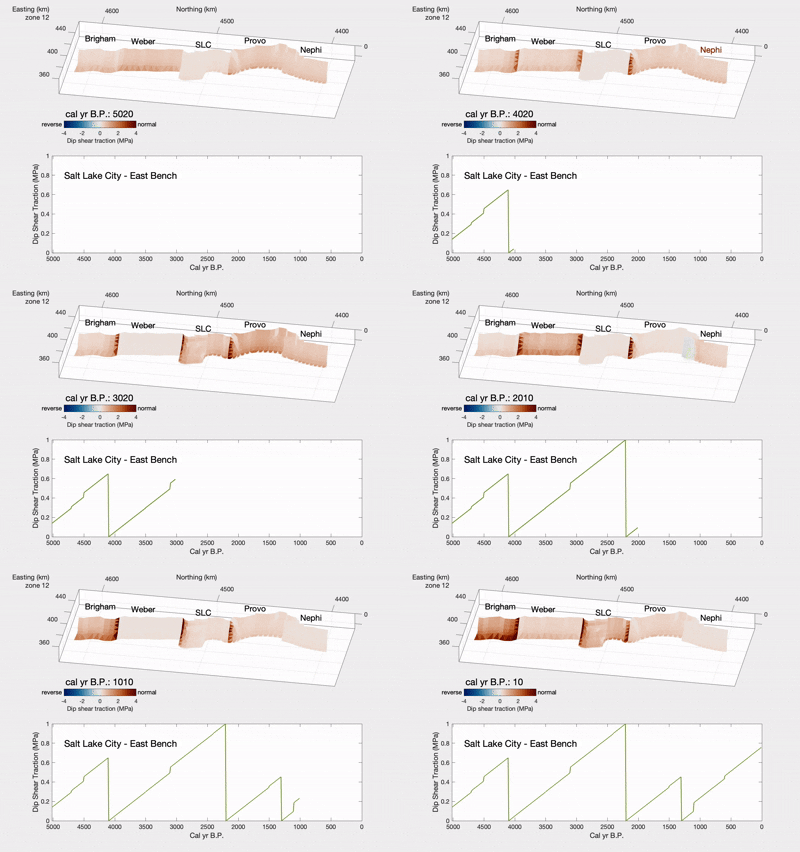
Earthquakes are hard to predict because the faults that cause them are largely hidden. We can map where faults break the surface and measure slip rates in some locations, but deeper fault structure remains out of reach; the stress that builds between and drives earthquakes cannot be measured directly. Understanding earthquake hazard means finding ways to see what we can't directly observe.
We develop 3D mechanical models to simulate deformation of active fault networks in southern California and Utah. These models illuminate fault system evolution over million-year timescales and stress accumulation over the past several thousand years. Along with geologic and geophysical evidence, the models reveal the mechanical conditions that drive large, damaging earthquakes.
Experimental Evolution of Active Faults
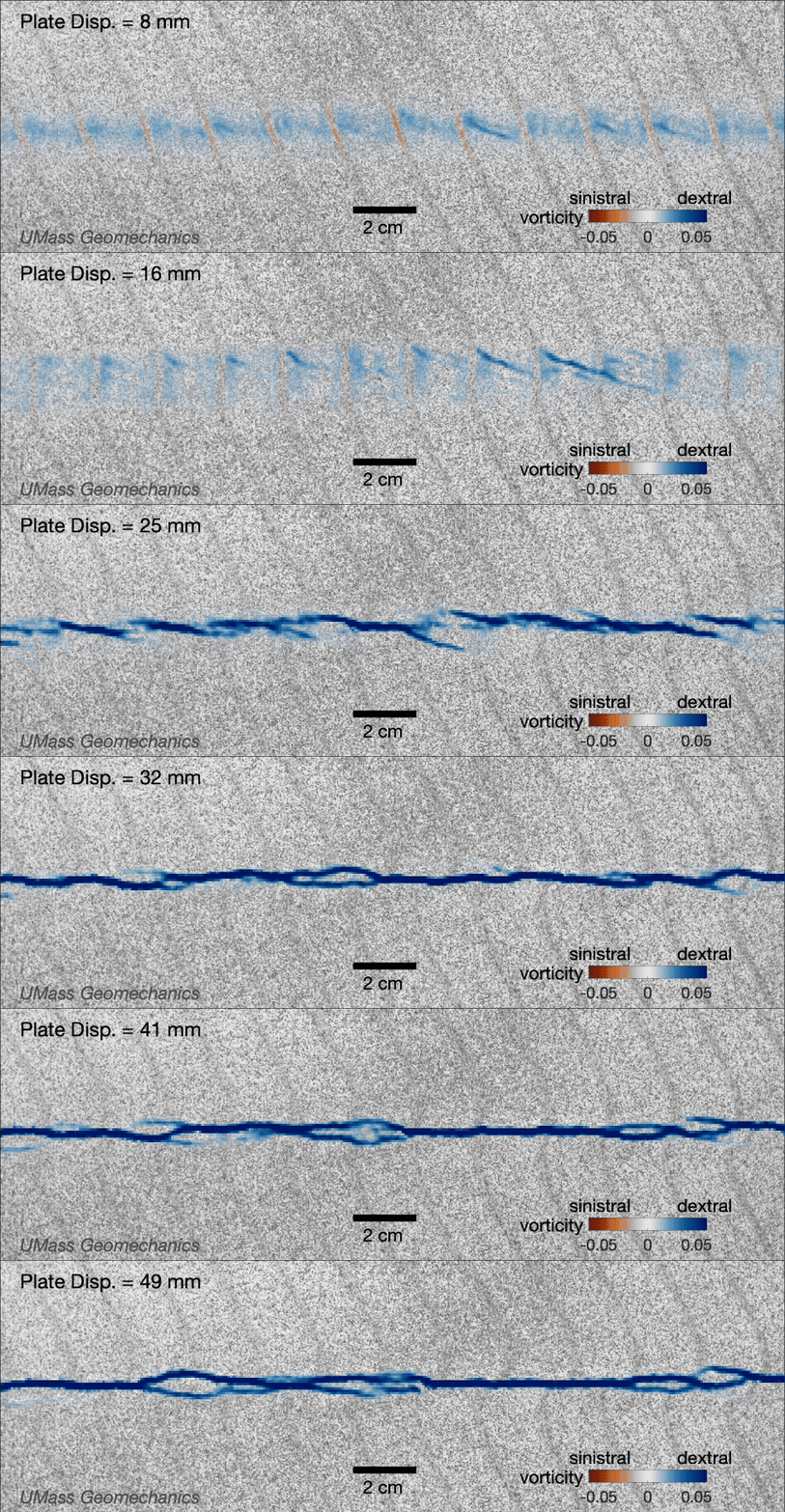
Faults take millions of years to evolve in the crust — far too slow to observe directly. In the laboratory, we compress that timescale into hours, using carefully scaled analog materials to recreate the complex, detailed evolution of faults, uplift, and off-fault deformation.
The physical modeling lab at UMass Amherst is equipped with state-of-the-art rheological instrumentation to ensure wet kaolin is carefully scaled to match crustal material properties. We directly document 3D deformation using a five-camera array for Digital Image Correlation and Structure-from-Motion analysis.

Fault Growth by Work Optimization
Do fault systems evolve to optimize work? Scaled physical experiments suggest they do. My former student Jess McBeck and I developed GROW, a Boundary Element Method code that simulates 2D fault growth through work optimization. The user prescribes an initial fault configuration, and the code propagates and adds faults that optimize the work of the entire system. We have used GROW to investigate fault initiation and growth across a remarkable range of scales, from the coalescence of microscopic flaws to the evolution of crustal-scale fault systems in contractional, strike-slip, and extensional tectonic settings.
Select Publications
For a comprehensive list of publications, visit Google Scholar.
* Student first authored publication